














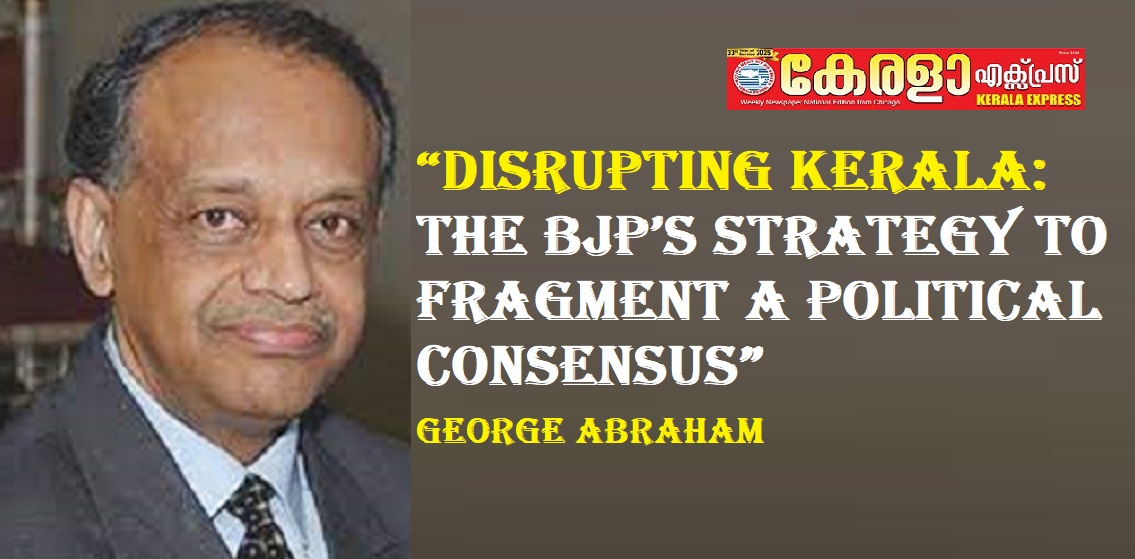
The effort by the Bharatiya Janata Party (BJP) to reach sections of the Christian community is not new, but it has become far more visible and strategically calibrated in recent years. This outreach includes engagement with different denominations, conversations around education and minority rights, and attempts to cultivate local leadership within Christian groups. The objective is not immediate large-scale vote conversion, but rather a gradual erosion of the long-standing alignment of Christians with the United Democratic Front (UDF), led by the Indian National Congress.
However, Kerala’s political landscape has historically been shaped by strong social coalitions and intersections of class, caste, and religion. The Christian community, especially in central Kerala, has had deep institutional ties, as educational, economic, and social with the Congress-led ecosystem. As such, any BJP “inroads” remain incremental rather than transformative in the short term.
The Bharatiya Janata Party has long sought to construct a pan-Hindu identity. Yet, the Hindu community in Kerala is far from monolithic. The state’s social history marked by caste hierarchies, reform movements, and struggles led by figures such as Sree Narayana Guru and Ayyankali, along with sustained efforts by Christian missionaries has fostered a political consciousness that resists easy consolidation along purely religious lines. Missionary initiatives in education, healthcare, and social reform played a crucial role in expanding access to literacy and challenging entrenched caste barriers, particularly among marginalized communities. These interventions not only contributed to Kerala’s high human development indicators but also reinforced values of social mobility and pluralism. Consequently, communities such as Ezhavas, Dalits, and various OBC groups have historically aligned with secular or left-leaning formations, particularly the Left Democratic Front (LDF).
What the BJP is attempting now is a reframing, shifting identity from a caste-fragmented Hindu society to a broader religious unity narrative. This has found some resonance among younger voters and in pockets influenced by national political messaging. Yet it continues to collide with Kerala’s entrenched political literacy and strong party networks.
Unable to fully consolidate Hindu voters, the BJP has turned to a more nuanced and arguably more unsettling strategy: fragmenting minority vote bases. The fiercest contest in this election is unfolding in Kerala’s so-called “Christian belt,” where voters can influence outcomes in nearly 40 constituencies. What was once a dependable support base for the UDF is now being deliberately unsettled. The BJP has made parts of this region electorally competitive not through mass conversion of voters, but through the steady injection of doubt, aspiration, and division.
For decades, Kerala’s Christians, especially in the central belt have stood firmly with the UDF. This alignment was not merely transactional; it was built on deep institutional and social foundations. The BJP’s objective is not to dismantle this relationship overnight, but to weaken it just enough to position itself as a “viable alternative.” In a tightly contested state, even marginal erosion can yield outsized political dividends.
Its pitch to sections of the Christian middle class is carefully constructed: development, dignity, and the promise of a “third option.” Beneath this messaging, however, lies a more complex playbook. Symbolic gestures such as Christmas visits, church outreach, and engagement with select clergy, are deployed to soften perceptions and create a veneer of inclusivity. These optics are not incidental; they are central to the strategy.
More troubling is the subtle use of fear as a political instrument. By selectively invoking global religious tensions, local incidents, and even the discretionary suspension of FCRA privileges, the Bharatiya Janata Party appears to be nudging sections of the Christian community toward a recalibrated political instinct—one shaped less by shared civic values and more by perceived insecurities. This is not overt polarization; it is calibrated suggestion.
Compounding this vulnerability is a leadership vacuum within the community. The absence of towering figures such as Oommen Chandy and K. M. Mani has left a void that no single leader has been able to fill. These were individuals capable of interpreting political signals, negotiating power, and maintaining cohesion. In their absence, fragmentation has become easier.
Migration has further weakened the community’s political leverage. With large numbers of young people living abroad, grassroots mobilization has thinned, even as global exposure reshapes aspirations. Add to this the internal divisions among Catholics, Orthodox, and Pentecostal groups, and the result is a community that is more segmented and therefore more susceptible to targeted political engagement.
Yet, despite all the outreach and optics, skepticism remains deep. Many Christians in Kerala are not evaluating the BJP in isolation; they are judging it in the context of its actions elsewhere in India. Reports of hostility toward minority institutions and communities in other states continue to cast a long shadow over the party’s overtures in Kerala. The recent concerns surrounding proposed changes to foreign funding regulations have only intensified these apprehensions.
The real danger, however, is not an immediate political takeover. It is something more insidious: the gradual erosion of Kerala’s pluralistic equilibrium. The state has long resisted binary politics that reduces identity to religion alone. Its strength has been its complexity, a society where caste, class, and community intersect in ways that prevent easy polarization. What is now underway is an attempt to simplify that complexity and redraw political identities along sharper, more divisive lines.
Whether this effort succeeds remains an open question. Kerala’s electorate has historically demonstrated a capacity for critical thinking and resistance to political overreach. But complacency would be misplaced. This election is not merely about who forms the next government; it is about whether Kerala will continue to define its politics on its own terms or allow itself to be reshaped by a model that has altered the political character of much of the country.
Kerala, after all, is not just another state. And it is certainly not a laboratory.
George Abraham