














When contemplating the span of human life, we often measure it in years. A century-long life is deemed extraordinary, a testament to longevity and resilience. However, when we shift our perspective to quantify life in days, the narrative changes dramatically. What was once perceived as a remarkable century-long life dwindles to 36,500 days. This dichotomy raises profound questions about the value and significance we attribute to life.
The Significance of Perspective.
The way we perceive time influences our attitude toward life. When measured in years, life appears expansive, allowing us to envision a broad timeline for achieving our goals and aspirations. Conversely, when quantified in days, life's brevity becomes starkly apparent, prompting us to reevaluate our priorities and make the most of each fleeting moment. This shift in perspective can be both empowering and daunting. On one hand, it encourages us to seize every opportunity and live life to the fullest. On the other hand, it can evoke anxiety and fear about the limited time we have.
The Value of Each Day.
If 36,500 days seem inconsequential compared to 100 years, what does this imply about the value of each individual day? Does the brevity of life in days diminish its significance, or does it amplify the importance of making every moment count? Perhaps the latter is true. When we recognize the limited number of days at our disposal, we are compelled to cherish each day, to prioritize what truly matters, and to cultivate meaningful relationships and experiences. Each day becomes a precious gift, filled with opportunities to learn, grow, and connect with others.
The Impact of Time Perception on Our Lives.
Our perception of time profoundly impacts our daily lives. When we view our life in years, we might focus on long-term goals and plan meticulously for the future. However, when we consider life in days, we're reminded to appreciate the present moment and make the most of the time we have. This mindset shift can lead to a greater sense of urgency and purpose.
We might ask ourselves: What can I accomplish today? How can I make a positive impact on those around me? By focusing on the present, we can break free from procrastination and make meaningful progress toward our goals.
Living in the Present.
The paradox of time encourages us to live in the present. Rather than fixating on the passage of years or the finitude of days, we can focus on the here and now. By embracing the present moment, we can tap into life's richness, appreciate its beauty, and find purpose in our daily experiences. Mindfulness practices, such as meditation and deep breathing, can help us cultivate a greater awareness of the present moment. By being fully engaged in the present, we can let go of worries about the past or future and find joy in the simplicity of life.
The Importance of Priorities.
When we recognize the limited number of days we have, we're forced to reevaluate our priorities. What truly matters in life? What brings us joy, fulfillment, and a sense of purpose? By clarifying our priorities, we can allocate our time and energy more effectively. We might discover that our priorities have shifted over time or that we've been focusing on things that don't truly align with our values. By reassessing our priorities, we can create a more authentic and meaningful life.
Conclusion.
The way we perceive time shapes our understanding of life's value. Whether measured in years or days, life is a precious gift. By acknowledging the paradox of time, we can cultivate a deeper appreciation for each day and make the most of the time we have. As the ancient Greek philosopher, Heraclitus, said, "No man ever steps in the same river twice, for it's not the same river and he's not the same man." Every day is a new opportunity to live, learn, and cherish the gift of life. By embracing the present moment, clarifying our priorities, and making the most of each day, we can live a life that is rich in purpose, meaning, and fulfillment.

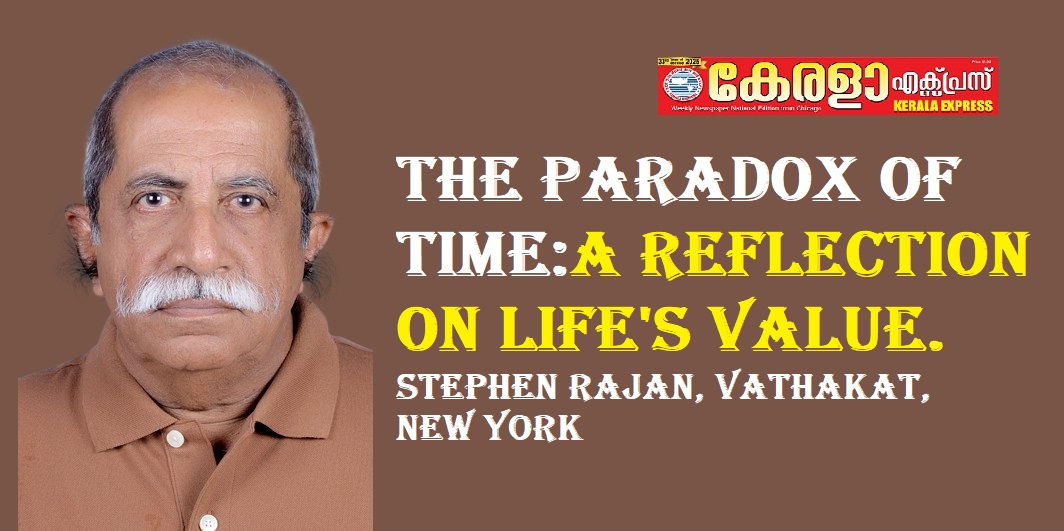
Stephen Rajan, Vathakat, New York