
















It is encouraging to see Kerala’s governance entrusted to the capable leadership of Chief Minister V.D. Satheesan and his team at a time when the state faces one of the most serious fiscal challenges in its history. The recently released White Paper has laid bare the alarming financial condition inherited from a decade of Left Democratic Front (LDF) rule. The findings paint a troubling picture of mounting debt, shrinking fiscal space, and limited avenues for generating new revenue. Kerala appears to be standing at the edge of a financial precipice, burdened by years of excessive borrowing and questionable fiscal management. Critics argue that while the state’s liabilities continued to soar, those at the helm displayed little restraint in public spending, leaving the incoming administration with the daunting task of restoring financial discipline and rebuilding public confidence.
The state has inherited payment arrears amounting to ₹48,733 crore from the previous LDF government—obligations that are legally due but remain unpaid. In addition, Kerala's outstanding liabilities, carrying substantial annual interest burdens, have reportedly crossed ₹5.07 lakh crore. Such a debt load is increasingly difficult to sustain without placing severe pressure on the state's finances. Over time, it threatens to undermine Kerala’s hard-earned achievements in literacy, public health, social welfare, and human development.
The real consequence of this mounting debt is that a growing share of the state's revenue must now be diverted toward servicing loans and meeting past obligations rather than being invested in infrastructure, education, healthcare, job creation, and other developmental priorities. Every rupee spent on debt repayment is a rupee unavailable for building the future. Unless the fiscal trajectory is corrected, the state's capacity to maintain its social commitments and developmental momentum could face serious constraints in the years ahead.
At present, salaries, pensions, and interest payments consume nearly 75 percent of Kerala's revenue receipts, leaving limited fiscal space for developmental spending. Despite running substantial fiscal deficits over the past decade, the state has devoted a relatively small share of its resources to roads, water projects, public infrastructure, and other long-term productive investments when compared with many peer states.
The LDF government's principal mechanism for financing development was the Kerala Infrastructure Investment Fund Board (KIIFB). However, the agency has faced criticism for its extensive reliance on off-budget borrowing, effectively operating outside the framework of normal budgetary oversight and governance. While projects worth nearly ₹1 lakh crore were announced under KIIFB, completed projects reportedly account for only about ₹25,000 crore. Critics have also questioned the allocation of resources, arguing that decisions were often influenced more by political considerations than by objective developmental priorities. Kannur district alone is said to have received nearly 20 percent of total KIIFB allocations, while critical infrastructure needs in districts such as Idukki and Wayanad remained inadequately addressed.
The report further highlights the mounting losses of major state-owned enterprises, including KSRTC, KSEB, and the Kerala Water Authority. Together, these three entities accounted for nearly 72 percent of the total losses incurred by state public sector undertakings. Rather than moving toward financial self-reliance, these institutions have become increasingly dependent on government support, adding further strain to the state's finances.
The 2025–26 budget also appears to rest on highly optimistic revenue projections. According to the report, there could be a revenue shortfall of approximately ₹20,500 crore, a gap that may significantly affect the government's ability to sustain existing welfare commitments and development programs.
More broadly, the Pinarayi Vijayan administration stands accused by its critics of governing through unrealistic assumptions, fiscal opacity, and political favoritism. For many observers, nothing symbolizes this disconnect more vividly than the image of a Chief Minister traveling with a motorcade of dozens of vehicles and approving the purchase of high-end luxury cars while presiding over a state facing severe financial distress. It raises an uncomfortable question: what became of the leaders who once claimed to champion the interests of workers, farmers, and the marginalized? Critics argue that there is a striking contradiction between invoking the ideals of revolutionary figures such as Che Guevara at political rallies and presiding over a culture of privilege and extravagance within the party leadership. To them, this represents not merely inconsistency, but a profound departure from the egalitarian principles the movement once professed to uphold.
The White Paper calls for restoring fiscal discipline through KIIFB restructuring, greater transparency in public finances, reform of loss-making state enterprises, improved revenue administration, and a gradual shift away from debt-driven governance toward sustainable economic management. Whether these reforms succeed will depend not only on political will but also on the government's ability to make difficult and, at times, unpopular decisions.
The challenge before Chief Minister V.D. Satheesan and his administration is formidable. Yet acknowledging the true extent of the crisis is the essential first step toward recovery. If the findings of the White Paper lead to meaningful reforms and responsible governance, Kerala may still be able to restore its fiscal health while preserving the social achievements that have long distinguished the state. The road ahead will be difficult, but transparency, accountability, and sound financial management offer the best path forward.
.jpg)
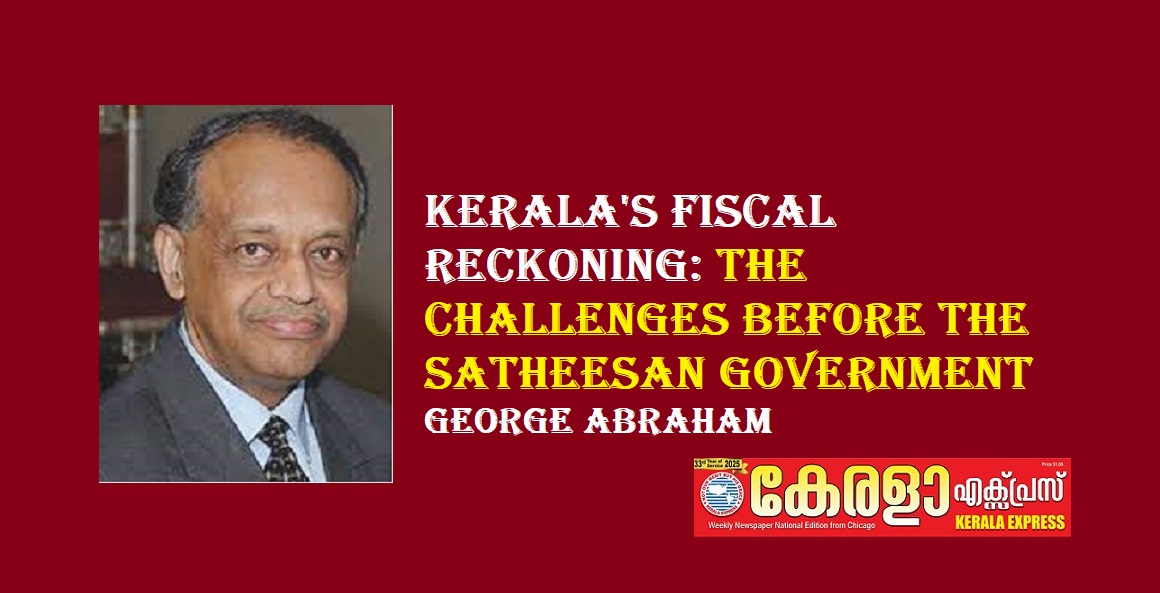
George Abraham