












The proposed delimitation exercise raises serious concerns about the future balance of political power in India.
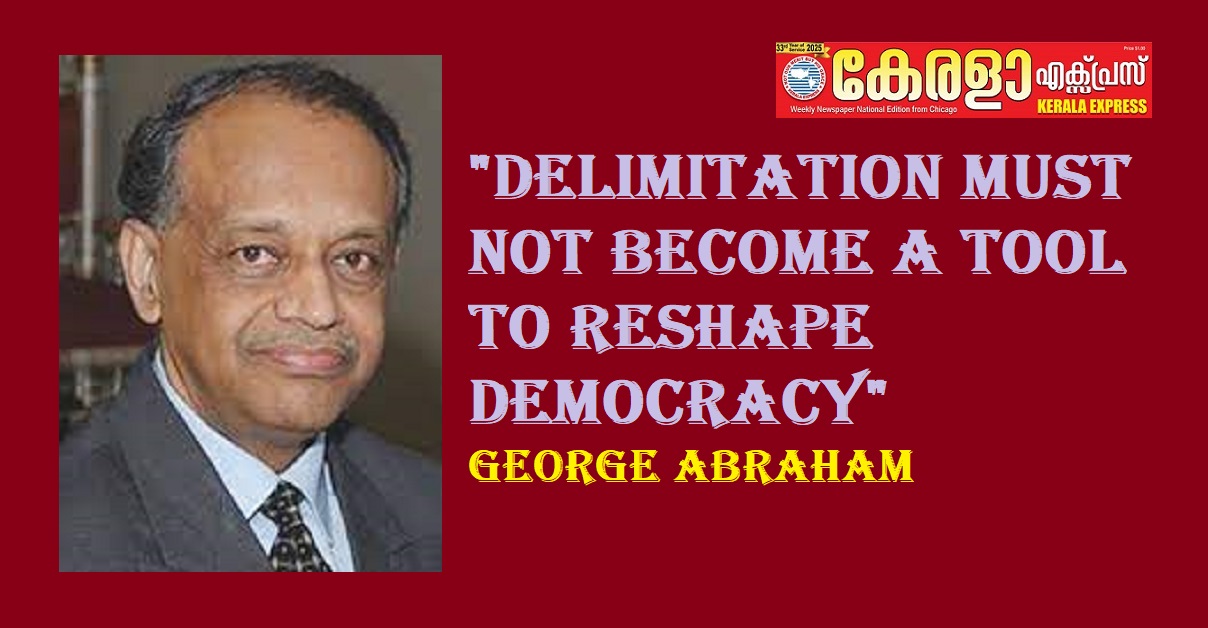
"Constituencies need to be adjusted as population changes. But the question is how it is done, who draws the lines, and whether the process can be used for political advantage" asked George Abraham, Vice-Chair of the IOCUSA.
"The southern states have legitimate concerns. Kerala, Tamil Nadu and others responded to the national call for population control and succeeded. They should not be punished in the future by steadily losing their political voice because population growth remained higher elsewhere. Even if the present formula protects the relative share of states for now, this larger question has only been postponed, not settled" added Mr. Abraham
There is also the danger of gerrymandering. When new constituencies are created, boundaries can be drawn in ways that concentrate one party's supporters and divide another's. That is why delimitation must be completely independent, transparent and open to public scrutiny.
Increasing women's representation is a noble and long-overdue goal. But tying the women's quota to such a controversial delimitation exercise takes some of the shine off that reform and naturally raises questions about its motivation. Women's representation deserves to stand on its own merit.
There may be political differences between Congress and the DMK, including Tamil Nadu and TVK. But broader constitutional interests should take precedence over temporary political disagreements. Nobody should throw the baby out with the bathwater.
This issue must also be viewed alongside other concerns surrounding the Election Commission, SIR, voter deletions, EVM transparency, and VVPAT verification. Each may be defended separately, but together they shape the entire electoral system. Who gets on the voter list? Who gets removed? Who appoints the Election Commissioners? Who draws the constituency boundaries? How are votes verified? These are not BJP questions or Congress questions. These are questions about Indian democracy.
A good democratic system should not depend on trusting Narendra Modi today or Rahul Gandhi tomorrow. It should be designed so that no political party can bend the system to its own advantage. India needs an independent Election Commission, a genuinely independent Delimitation Commission, transparent voter rolls, wider VVPAT verification, public scrutiny of constituency maps, and strong judicial oversight.
That is the democratic India we should build.
George Abraham
Vice Chairman
Indian Overseas Congress USA