
















Abstract
Recent public discourse questioning the patriotism of Christians and portraying the Church as being opposed to national interests raises significant constitutional concerns. Such assertions are inconsistent with India's constitutional framework, judicial precedents, and historical evidence. This article examines the constitutional status of Christian institutions, their legal rights, and their immense contribution to nation-building through education, healthcare, and humanitarian services.
Introduction
India is a secular democratic republic founded upon the principles of liberty, equality, fraternity, and pluralism. The Constitution does not recognize any citizen as more or less patriotic on the basis of religion.
The suggestion that Christians must choose between "the Church" and "the Nation" creates a false constitutional dichotomy. A citizen's religious identity and constitutional loyalty are not mutually exclusive.
For nearly two thousand years, Christianity has been part of India's social fabric. Rather than weakening the nation, Christian institutions have strengthened it through education, healthcare, humanitarian relief, and social reform.
Constitutional Protection of Christian Institutions
The Constitution of India guarantees equal citizenship irrespective of religion.
Article 14
Equality before law and equal protection of laws.
Articles 15 and 16
Prohibit discrimination on grounds of religion.
Article 19(1)(a)
Freedom of speech and expression.
Article 21
Protection of life and personal liberty, interpreted to include dignity, education, healthcare, and quality of life.
Article 25
Freedom of conscience and the right freely to profess, practice and propagate religion.
Article 26
Every religious denomination has the right to establish and maintain institutions for religious and charitable purposes.
Article 29
Protection of minority culture and educational rights.
Article 30
Religious and linguistic minorities have the constitutional right to establish and administer educational institutions.
These rights are fundamental rights—not concessions granted by the State.
Judicial Recognition by the Supreme Court
The Supreme Court has consistently protected the constitutional rights of minority institutions.
1. The Kerala Education Bill, 1957 (Advisory Opinion)
The Supreme Court recognised that Article 30 exists to preserve minority identity through educational institutions.
2. St. Xavier's College v. State of Gujarat (1974) 1 SCC 717
The Court held that minority institutions possess autonomy in administration and that Article 30 is intended to preserve their character and excellence.
3. T.M.A. Pai Foundation v. State of Karnataka (2002) 8 SCC 481
An Eleven-Judge Bench held that establishing and administering educational institutions is a fundamental constitutional right.
4. P.A. Inamdar v. State of Maharashtra (2005) 6 SCC 537
The Court reaffirmed the autonomy of minority educational institutions while balancing regulatory powers of the State.
5. Bijoe Emmanuel v. State of Kerala (1986) 3 SCC 615
The Supreme Court held that patriotism cannot be judged merely by outward demonstrations. Genuine religious beliefs deserve constitutional protection.
This judgment clearly establishes that constitutional patriotism accommodates religious freedom.
Christian Institutions: Partners in Nation Building
Christian institutions constitute one of India's largest voluntary service networks.
Education
Christian organisations administer approximately:
55,000–60,000 schools
More than 500 colleges
Universities
Teacher-training institutions
Nursing colleges
Engineering colleges
These institutions educate more than 25 million students, most of whom are non-Christians.
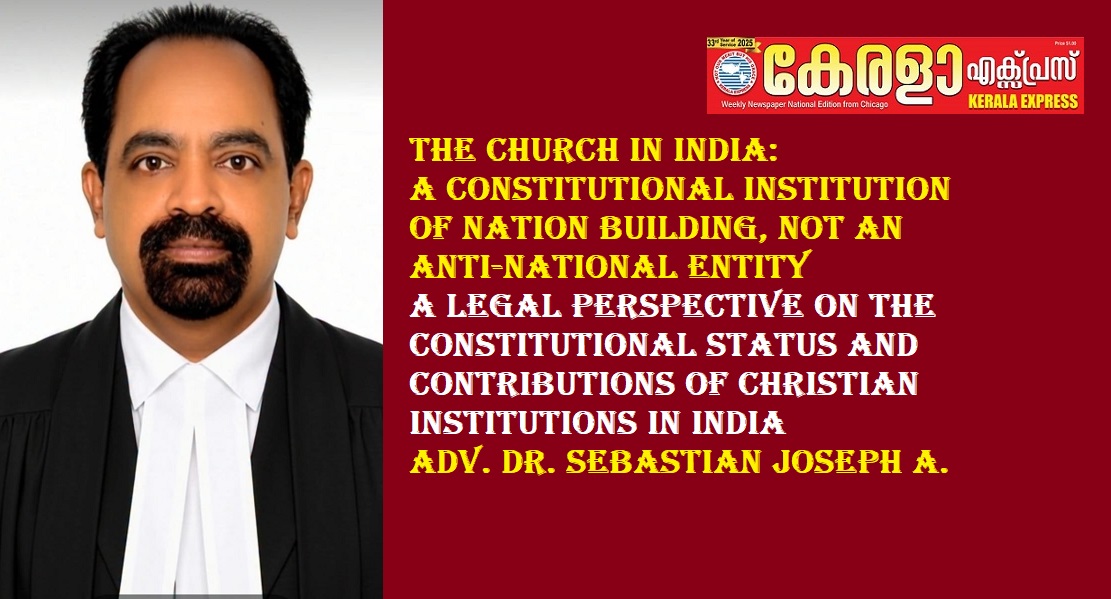
.jpg)
Adv. Dr. Sebastian Joseph A.
M.A., LL.M., Ph.D. Advocate, Supreme Court of India
Renowned institutions include:
St. Stephen's College
Madras Christian College
Loyola College
St. Xavier's Colleges
Christ University
St. Joseph's University
Sacred Heart College
Thousands of IAS officers, judges, doctors, scientists, military officers, and political leaders are alumni of Christian institutions.
Healthcare
Christian healthcare institutions operate:
Thousands of hospitals
Rural health centres
Dispensaries
Nursing schools
Medical colleges
Institutions like Christian Medical College (CMC), Vellore, and St. John's Medical College, Bengaluru, are internationally respected centres of excellence.
Mission hospitals serve patients irrespective of religion, caste, or language.
Social Welfare
Christian organisations run:
Orphanages
Old-age homes
Homes for differently abled persons
Tribal development programmes
Women's empowerment centres
Disaster relief programmes
Rehabilitation centres
De-addiction centres
These activities directly advance the Directive Principles of State Policy under Part IV of the Constitution.
Christian Contribution to Public Health
Long before government healthcare expanded into rural India, Christian missionaries established:
Primary healthcare
Leprosy hospitals
Tuberculosis treatment
Maternal healthcare
Nursing education
Their contribution significantly complements the State's constitutional obligation under Article 47 to improve public health.
Constitutional Patriotism
Patriotism in India is defined by constitutional values rather than religious identity.
Every Christian citizen:
Pays taxes.
Obeys Indian law.
Votes.
Serves in the armed forces.
Serves in the judiciary.
Serves in civil administration.
Contributes to economic development.
The Constitution nowhere requires a citizen to subordinate religious identity in order to demonstrate patriotism.
International Human Rights Law
India is also bound by international human rights obligations.
Universal Declaration of Human Rights (1948)
Article 18 guarantees freedom of religion.
International Covenant on Civil and Political Rights (ICCPR)
Article 18 protects religious freedom.
International Covenant on Economic, Social and Cultural Rights (ICESCR)
Recognises the role of private institutions in education and healthcare.
Christian institutions help India fulfil these international obligations.
Legal Fallacy in Branding the Church as Anti-National
Legally speaking, merely belonging to or supporting a church cannot amount to anti-national activity.
Under Indian law:
Patriotism is not determined by religion.
Criminal liability is always individual.
No religious denomination can be collectively branded anti-national without evidence.
Such generalisations violate:
Article 14
Article 15
Article 21
Article 25
and undermine India's constitutional commitment to secularism, as recognised in S.R. Bommai v. Union of India (1994) 3 SCC 1, where the Supreme Court held that secularism is part of the Basic Structure of the Constitution.
Conclusion
The Constitution protects the Church not as a matter of privilege but as a matter of fundamental rights. Christian institutions have served India for centuries by educating millions, healing the sick, uplifting the poor, and promoting human dignity.
To portray the Church as anti-national is not supported by constitutional law, judicial precedent, or historical fact. The true constitutional position is that religious freedom and patriotism coexist harmoniously.
A Christian can be fully devoted to Christ while remaining fully loyal to the Republic of India. Indeed, the Church's long history of service demonstrates that its commitment to faith has consistently translated into service to the nation.
The Church in India is not a threat to the Republic; it is one of the Republic's enduring partners in nation-building.
disclaimer : The statistical figures used in this article are based on conventional and publicly available sources. Readers are advised to verify the latest data with the appropriate Government authorities and official institutions before relying on the statistics for academic, legal, or policy purposes.